A stress tracker for iPhone

EVEN

Sleep better. Feel lighter. Know exactly what did it.

Even learns which small things work for you, then shows you they did.

For iPhone, iOS 18 or later. Your score is free.

Spent: a soft rose mark with a downturned mouth
Spent0 – 19
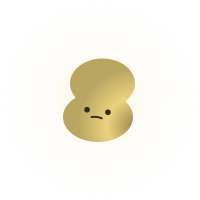
Stretched: a yellow mark pulled thin at the waist
Stretched20 – 39
Steady: a blue cushion at rest, with a level mouth
Steady40 – 59
Light: a teal bloom, open, smiling
Light60 – 79
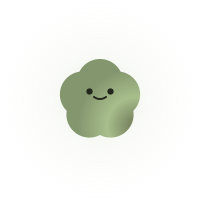
Bright: a green bloom, further open, smiling wider
Bright80 – 100

Five words for how a day went, and one number behind them.

Every morning

One number you can actually do something with

Your Even score runs from zero to a hundred, and higher is lighter. It is read from the night you just had and the days behind it, against your own usual rather than a population average, so a good score means good for you.

Under it there is one sentence, in plain words, about what today can hold. Not nine dials and a wall of charts to interpret before breakfast. Tap the number and it opens into everything it was made of.

What the score is made of →

Even's Today screen: an Even score of 26 of 100, stretched and below the person's usual, one line of plain-language advice, and the night's sleep, HRV, resting heart rate and energy underneath

What the score is made of

Five parts, each one measured, none of them guessed

Each part is a published instrument or a real population anchor, and each is read against your own history. If a part cannot yet be read honestly, Even says so and leaves it out rather than filling the gap with an estimate.

Sleep

How the nights went: length against the sleep you aim for, how broken, how late, and how steady one night is against the next.

Sleep, wrist temperature

Body

What your body did at rest. Heart rate variability, resting heart rate and breathing rate, each against your own baseline.

HRV, resting HR, respiratory rate

Demand

How hard the day itself was. Four quick sliders at check-in, adapted from the workload instrument NASA has used since 1988.

NASA Task Load Index

Mood

How it landed, in your own words. Logged on Apple's State of Mind model, so it reads and writes to Health both ways.

Apple State of Mind

Activity

What you asked of your body and what it gave back. Steps, energy, exercise minutes and time in daylight.

Activity, daylight

How the number is put together →

Ninety days of Even score drawn as a line from June to August, with the person's own usual notched across it, the hardest week marked, and the sleep and body parts broken out below

Day one

You are not starting from zero

Most trackers begin counting the day you install them and ask you to wait a month before they say anything useful. Yours has been counting for years, and Even opens by reading ninety days of it back to you.

The month your nights settled. The week your resting heart rate came back down. Which day of the week takes the most out of you, every week. It is your own record, so it is worth trusting, and it means the app is useful the first evening rather than in October.

The sleep measure almost nobody knows about themselves →

The loop

Most trackers stop at the number. Even keeps going.

A recovery score that tells you your HRV dropped and then leaves you holding it has done the easy half. Even closes the circle: it reads you, offers something small, measures what the something did, and gets better at choosing next time.

01

Read

One score in the morning, with one line about what it means for today.

02

Offer

Three things worth doing, chosen for your state, the hour, and the shape of your week.

03

Do

Two minutes to twenty, inside the app, so the measurement survives.

04

See

Your heart settled nine beats in six minutes. One tap for how it felt. Proof, in your own numbers.

05

Learn

What helps you moves up the list. What does not moves down. In a month the app is measurably better at you.

The sessions

Small things, and the right one for right now

Two minutes to twenty. Every session has a published reason to exist and leaves a reading behind, and every one lands back in Apple Health as mindful minutes. Nothing here asks for thirty days of discipline.

Even's session library: paced breathing, nature sounds, ambient songs, an evening wind-down, a walk outside, guided writing and a second look

The library

Eight ways in, none of them generic

Two minutes to twenty. Every one has a published reason to exist.

A walk outside: twenty minutes or ten, with something to look for along the way and the phone keeping the time

The measured walk

Twenty minutes outside, and what it does to your numbers

Guided stretching: an overhead reach, the first of eight moves, with reps counted and the time left in the session

Guided stretching

Eight moves, five minutes, counted for you

Guided writing: the prompt write about someone who made today easier, above a few lines the person has typed

Guided writing

One question, taken from your own day

A session playing: morning rain, a voice singing over steady rain, with the screen free to lock while the sound keeps going

While it plays

Lock the screen. It keeps going.

What works for you

It gets better at you every week

Breathing settled your heart after five sessions out of five. The walk after two out of two. That is your record, and it is what lets Even stop guessing and start choosing.

Even ranks rather than scores, because at this sample size saying which helped most is honest and saying how much would not be. When it does not know yet, it says how close it is instead of inventing a percentage.

How Even reads you →

What works for you, ranked: paced breathing first with the heart settling after five of five, a walk outside second, an evening wind-down third, guided stretching fourth
The check-in: how did today land, with the Light mark selected, a word for it, what it was about, and four sliders for how hard the day was

Ten seconds, twice a day at most

Say how it landed. That is the whole ask.

Slide to the mark that fits, and stop there if you like. A word for it and what it was about are optional, and so are the four sliders for how hard the day was.

Even is built so it can never make you feel bad for not opening it. There are no streaks to break and no red badges. What you tell it goes straight into the part of the score it cannot measure from a wrist, and into learning which sessions land for you.

Grounded in published work

Every reading has a paper behind it, and the paper is listed

Even is designed on peer-reviewed research, and the app carries the full list, with journals, years and DOIs, one tap from anywhere it makes a claim. If a number cannot be computed from your own data, Even says so instead of estimating it.

Harvard Universityhow Even learns what works for you

University of Michiganthe right help at the right moment, and the walk

University of Pennsylvaniawhy short sleep shows up as attention first

Boston Universitypaced breathing

World Health Organizationthe well-being check

NASAthe daily day rating

All nine studies, with DOIs →
What leaves the phone

Your readings sync. Your Health data does not.

Even keeps learning you across the iPhones you sign in on, so it needs an account, and it says exactly what that account holds. No advertising, no tracking, and nothing sold or shared for anyone else's purposes.

Syncs to your account

  • Your first name and the email you signed in with
  • Daily scores and the five parts behind them
  • Check-ins, moods, and how a session landed
  • Which sessions were offered, and which you opened
  • Whether you have a subscription

Never leaves the phone

  • Any raw sample from Apple Health
  • Your heart rate series, minute by minute
  • Your sleep stages, workouts and cycle data
  • The words you write in a journal or a second look
  • Your location, at any point, ever

Deleting your account removes the account, everything synced under it, and everything on the phone. Read the full privacy policy.

Start with the ninety days you already have

Tonight is a good night to find out.

For iPhone, iOS 18 or later. Better with an Apple Watch, and it works without one.

Even describes patterns in your own data. It is not a medical device, it does not diagnose or treat anything, and nothing in it is medical advice. If something you see worries you, talk to a clinician.